Great expectations
This month for my book review I have read the classic Charles Dickens novel 'Great expectations'.
The background to the book is quite interesting. Dickens initially published the novel in several instalments for his magazine 'all year round'. In typical Dickens style he tried to leave cliffhangers at the end of each section to keep readers interested in the story and to encourage them to read more. This reminds me of how today all the soaps and dramas on TV are continuing on this technique. Also before you start the novel you should be aware that there are two endings. This is because Dicken's publishers found the initial one too depressing and sad, they preferred the second ending as it was a little bit more hopeful and uplifting and as a reader I would have to agree with them.
The plot to the novel is quite complex as so many characters come in and out, however I will try my best to give you the basic summery. On one misty Christmas eve long ago, an eight year old Pip was visiting the tombs of his parents and siblings when he had a terrifying encounter with an escaped convict. The convict intimidates Pip into stealing food from his sisters house and a file from her blacksmith husband. The guards eventually capture the convict and send him back to the prison ship from which he escaped. Throughout his childhood Pip could never forget his dealings with this convict and he lives in constant fear that he will return.
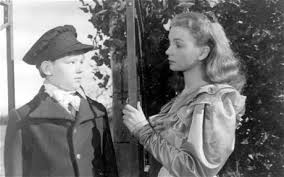
Meanwhile a wealthy spinster named Mrs Havisham has asked Pip's Uncle Pumblechook to find her a child to play with her beloved adopted daughter Estella. Uncle Pumblechook turns to Pip straight away. Whilst visiting the house Pip realises that Estella is a cold hearted and haughty girl however it's too late, Pip has already fallen in love.
While this is all occurring, Pip receives a mysterious letter from a top lawyer named Mr Jaggers saying that he is being sent to London to become a gentleman. It is still unknown who is giving Pip his fortune and you will have to keep reading to find out!
There are many interesting and intriguing characters in Great expectations, however if I had to pick the most it would be Mrs Havisham.
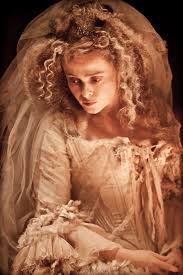
In many of the film adaptations of the novel she is portrayed as a cold and frail old women, however in the novel she actually starts off in her mid-fifties. Mrs Havisham is very obviously living in the past. She has been wearing her faded old wedding dress for the past 25 years, she refuses to dispose of her decaying wedding feast and all the clocks in her house are stopped at twenty five minutes to nine. Mrs Havisham is frozen in a time capsule, this made me very curious as to what caused her to take these actions. Something very bad must of happened.
Also I loved how romantic Mrs Havisham is. While most other people would of tried to move on with their lives after a heart break, Mrs Havisham refused to do so which I found very interesting and entertaining to read about.
Likewise I found Mrs Havishams relationship with her daughter Estella very interesting.She never really gave Estella a chance of a normal upbringing or at creating her own identity. Mrs Havisham used Estella as a tool to avenge her own broken heart and she used her beauty to torture men. At the beginning it almost seemed as if Mrs Havisham was gaining some sort of pleasure from watching Estella breaking Pip's heart. Their mother/ daughter relationship is definitely not the norm, it's actually quite sick and twisted however it was very captivating to read about.
Great expectations has a prevailing theme of social class which I think is just as relevant today as it was back in the 18th century. Dickens teaches us throughout the novel that loyalty, love and conscience is much more important than wealth, social advancement and class.
In Great expectations Dickens explores the class system of Victorian England, ranging from the most unlawful criminals[ Pip's conflict] to the poor peasants of Kent's marshes[Joe and Biddy]; to the middle class [Pimblechook] to the extremely wealthy[Mrs Havisham]. When Pip first learns of his great expectations he grows ashamed of his humble beginnings and aims to become a gentleman; he abandons his honest and good-natured Uncle Joe and his kind and hard working friend Biddy in search of a 'better life'. However when the wealthy but cruel Estella breaks Pip's heart and the royal but unpleasant Dummble betrays Pip he begins to understand that life as a gentleman is no more satisfying- and certainly no more moral than his previous life as a blacksmiths apprentice.
I suppose that we can all relate to Pip. We sometimes to can be idealists; whenever we can conceive of something better than what we already have, we immediately desire to obtain improvement. This novels theme reminds me of how grateful we should be for what we have and not to get caught up in all the 'great expectations' that are probably not even as great as they seem.
Great expectations is set in the mid-nineteenth century. At the beginning of the novel took place in the marshes in Kent and further on it took place place in London. Dicken's portrayal of England at that time is so descriptive it's like a time capsule where the reader gets many insights into that world.
Firstly I learned how important social class was at that time. I am aware that it still is a significant subject today however I found that it is not to the same extent. A good example of this would be Joe's changed behaviour towards Pip once he became a gentleman. Before hand they were considered equals, in fact Joe often referred to them as 'the best of pals'. However when Joe visits the newly-respectable Pip in London he clunches his hat 'like a bird's nest with eggs in it'' and even addresses Pip as 'Sir'. Later on in the novel Joe even say's that he can no longer act as Joe father or friend and tells Pip that he has become too privileged for them to be together and that he must leave.
Another insight that I gained into the world of the novel is the lack of opportunities that most children had at that time. Before Pip became a gentleman it was assumed that he would become a blacksmith with Joe as their was no other educational opportunities available. Nowadays, in the first world at least every child can go to school and become whatever they want to be.
What I also noticed about the novel is that it had a different viewpoint and vision about the role of women. One example of this would be how people address Pip's sister as only Mrs Joe or Mrs Geogory, this shows a central female character being defined in terms of her relationship with a man rather than being referenced by her first name like everyone else. Another example would be that Mrs Havisham's only goal in life was to become a bride and she had no career goals or aims.
Overall I enjoyed this novel because of its interesting characters and storyline. It is like a romantic, mystery and thriller novel all wrapped into one and I strongly recommend you reading it.